Abstract
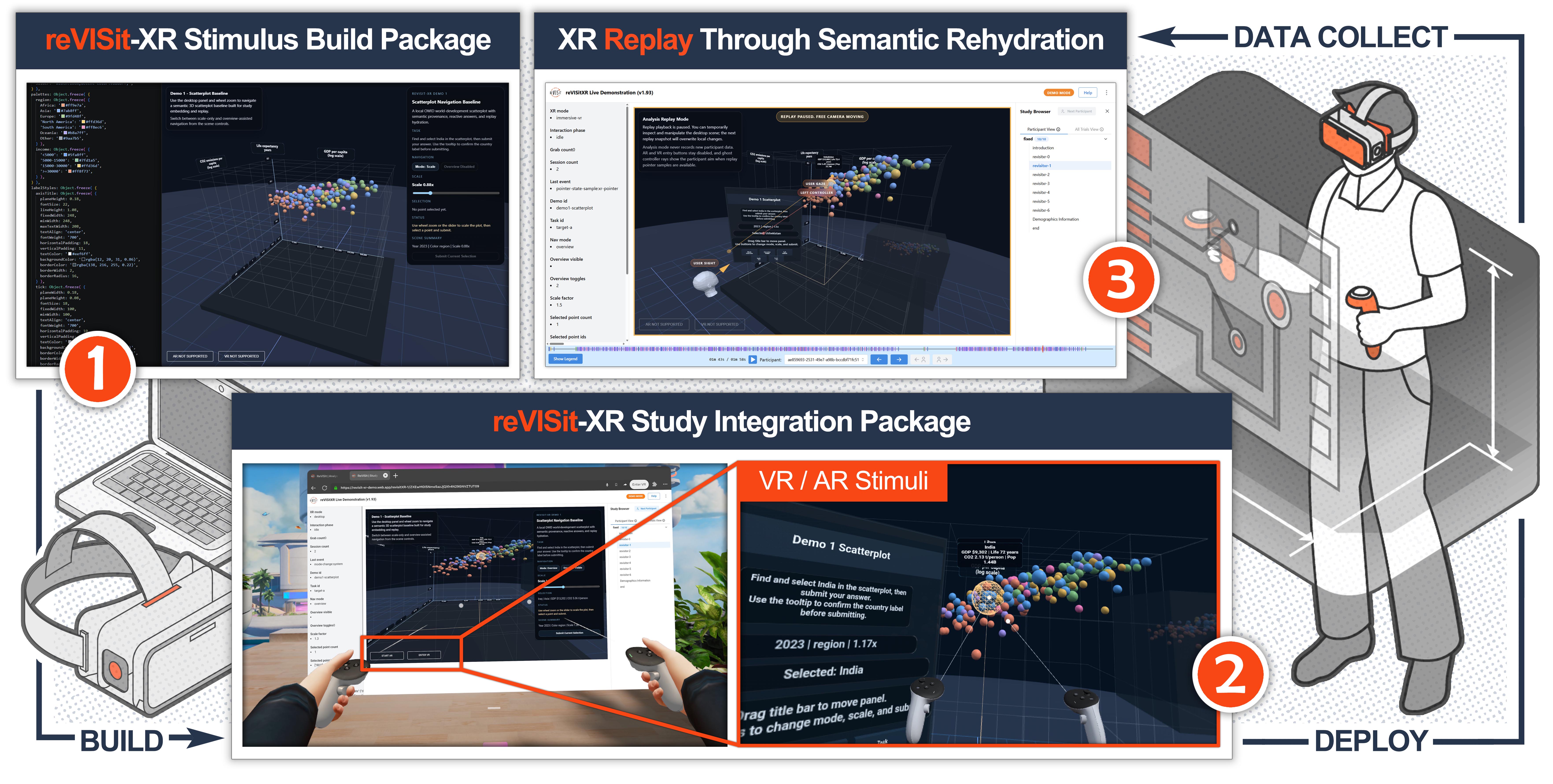
Extended reality (XR) is increasingly a setting for empirical visualization research, where study-relevant state is distributed across headset and controller pose, scene configuration, selections, spatial layouts, and AR anchors. Existing XR tools support parts of the workflow, such as scene authoring, interaction, or session analysis, yet seldom treat an XR stimulus as a reusable component of a complete study lifecycle. We present reVISit-XR, an extension of re-VISit that makes customizable WebXR stimuli embeddable, trackable, and replayable within empirical visualization studies. reVISit-XR sequences XR scenes alongside standard study components, collects reactive task responses, captures scene-authored semantic state together with generic XR traces, and rehydrates participant sessions for later desktop and headset analysis. Organized as a reusable stimulus build package and a study integration package, it lets XR stimuli act as first-class study components. We demonstrate its scope and feasibility through seven integrated, reusable examples and a deployed study, and discuss its current capabilities and future extensions.
BibTeX
@article{liang2026revisitxr,
  title={reVISit-XR: Bringing Extended Reality into Embeddable, Trackable, and Replayable Visualization Studies},
  author={Liang, Shano and Chen, Max and Harrison, Lane},
  journal = {Proceedings of the 2026 IEEE Visualization and Visual Analytics Conference},
  volume = {},
  number = {},
  url={https://arxiv.org/abs/2610.08700},
  year={2026},
  organization={IEEE}
}