Abstract
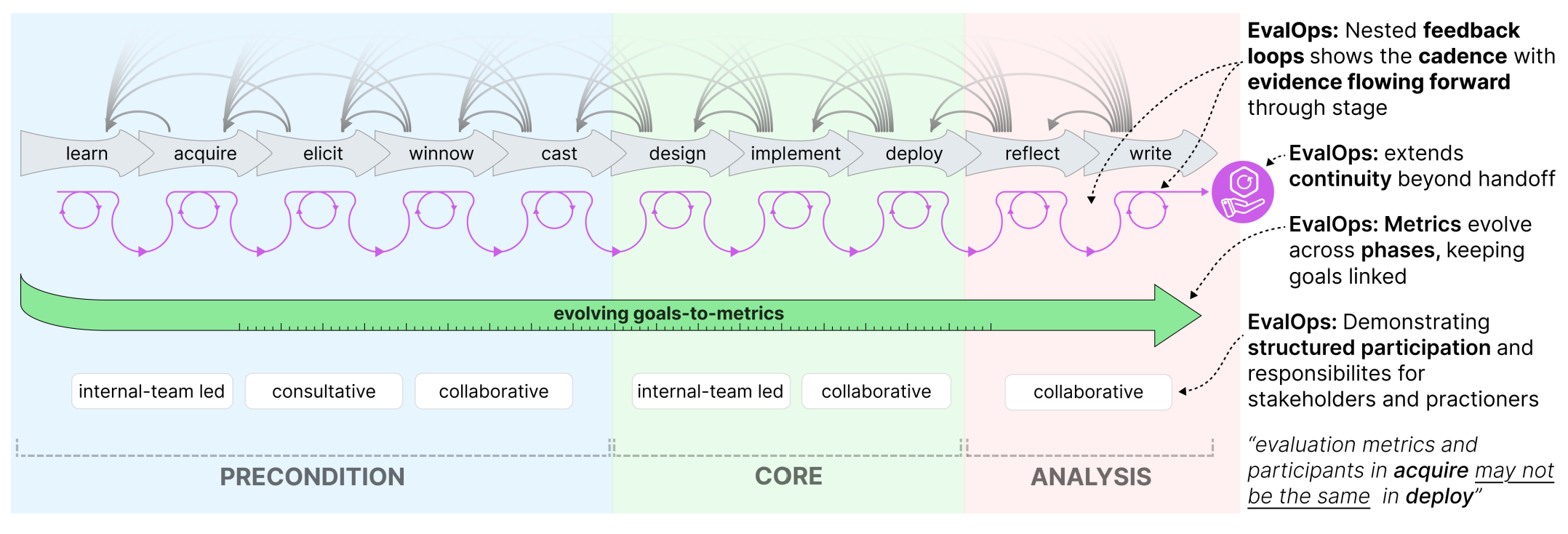
Existing frameworks in visualization and HCI emphasize iteration, data grounding, and stakeholder needs; however, they have not fully explored how evaluation might persist across phases, adapt to compressed timelines, and aid stakeholder engagement and elicitation. Building on prior frameworks, we introduce Evaluation-first design EvalOps that centers evaluation as a material component in the design process, emphasizing tighter feedback loops, co-evaluation with stakeholders, malleable forms of evaluation, and goals-to-metrics grounding. We illustrate how EvalOps shapes design outcomes through two case studies of data-visualization and LLM-enabled reasoning tools, demonstrating how evaluation-driven design facilitates alignment and trust, uncovers opportunities earlier, and supports cohesiveness under rapidly changing constraints. We contrast EvalOps with current visualization design methodologies and discuss opportunities for expanding evaluation-centered framings to other active areas of design research.
BibTeX
@inproceedings{10.1145/3772318.3791057,
author = {Shrestha, Bijesh and Shrestha, Hilson and Bonilla, Karen and Crouser, R. Jordan and Harrison, Lane},
title = {Evaluation-First Design for Data Visualization Interfaces},
year = {2026},
isbn = {9798400722783},
publisher = {Association for Computing Machinery},
address = {New York, NY, USA},
url = {https://doi.org/10.1145/3772318.3791057},
doi = {10.1145/3772318.3791057},
abstract = {Existing frameworks in visualization and HCI emphasize iteration, data grounding, and stakeholder needs; however, they have not fully explored how evaluation might persist across phases, adapt to compressed timelines, and aid stakeholder engagement and elicitation. Building on prior frameworks, we introduce Evaluation-first design EvalOps that centers evaluation as a material component in the design process, emphasizing tighter feedback loops, co-evaluation with stakeholders, malleable forms of evaluation, and goals-to-metrics grounding. We illustrate how EvalOps shapes design outcomes through two case studies of data-visualization and LLM-enabled reasoning tools, demonstrating how evaluation-driven design facilitates alignment and trust, uncovers opportunities earlier, and supports cohesiveness under rapidly changing constraints. We contrast EvalOps with current visualization design methodologies and discuss opportunities for expanding evaluation-centered framings to other active areas of design research.},
booktitle = {Proceedings of the 2026 CHI Conference on Human Factors in Computing Systems},
articleno = {443},
numpages = {8},
keywords = {Visualization, Design Study, Evaluation},
location = {Barcelona, Spain},
series = {CHI '26}
}